• kasipalayamcetp@gmail.com
  • +91 98940 42128

Phase - III - Reject management system

Phase III

Reject management system

Two primary reject streams are generated in the treatment system: the reject water from the RO system and the wastewater produced during softener regeneration. The RO reject is pumped to the thermal evaporation system, while the regeneration wastewater, referred to as BDTRF, is directed to the reactor clarifier.
In the reactor clarifier, total hardness and colour are reduced through the addition of hydrated lime and soda ash. The clarified supernatant is then transferred to the FCE. The settled sludge is routed to a sludge thickener followed by a filter press for dewatering. Filtrate from both the filter press and the sludge thickener is recycled back to the reactor clarifier feed tank. The dewatered sludge is collected, stored, and supplied to cement industries under an agreement for beneficial reuse.
Chloride Stream Sodium Sulphate Stream Multiple Effect Evaporator- II Multiple Effect Evaporator- I Brine Preparation Crystallizer Adiabatic Chiller Mother Liquor Sodium Chloride Salt Glabour Salt Brine Solution
  • 1. Multiple Effect Evaporator (MEE) & Adiabatic Chiller
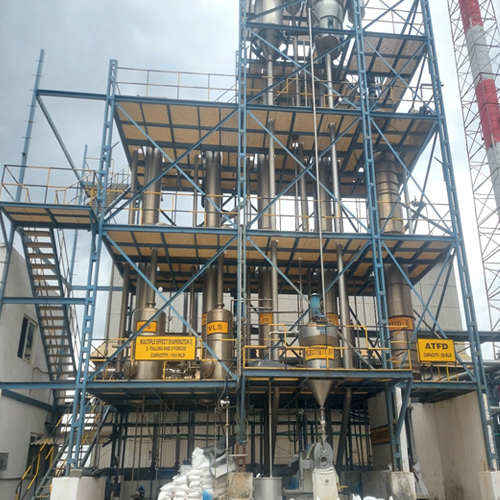
    The reject from the nanofiltration system is fed into the MEE to achieve further concentration. The condensate generated from the MEE is collected and pumped to the product water storage tank. Within the MEE, salt concentration increases from approximately 130 g/L to 350 g/L, making it suitable for further processing in the adiabatic chiller.
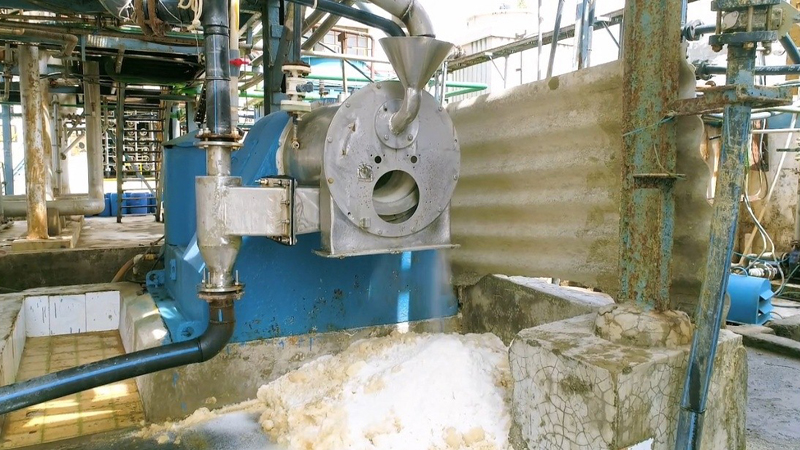
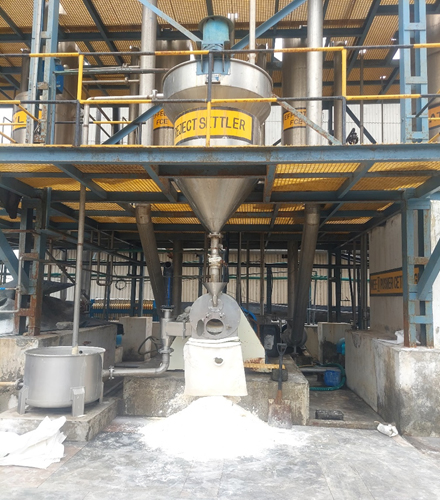
    In the adiabatic chiller, salts are crystallized at low temperatures. The crystallized salts are then sent to a centrifuge, where Glauber’s salt is separated, collected in bags, and recycled back to member units. The remaining liquid from the centrifuge, known as mother liquor, undergoes chemical treatment and is subsequently fed to the FCE for further recovery of anhydrous salts.
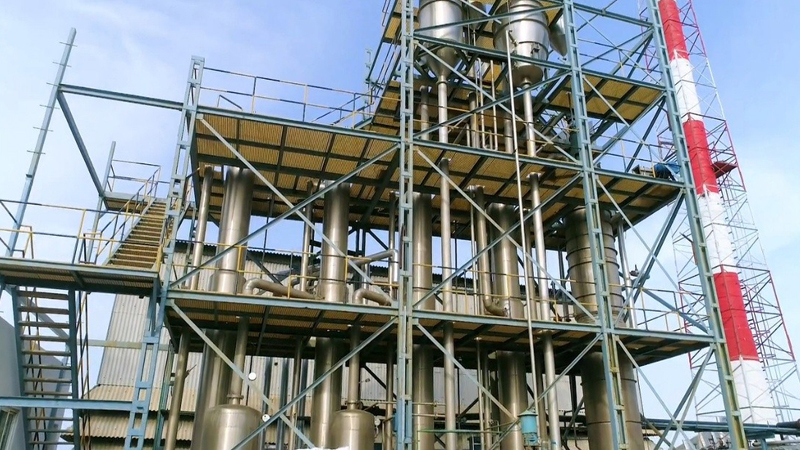
    Multiple Effect Evaporator
    Adiabatic Chiller
  • 2. Chloride Concentration Reverse Osmosis (CCRO)
    The CCRO system receives nanofiltration permeate, primarily consisting of sodium chloride solution with a concentration of 45–50 g/L. Through the CCRO process, the TDS is increased to approximately 80 g/L. The permeate, having a low TDS of around 0.5 g/L, is reused by member units. The reject stream from CCRO is directed to the chloride MEE system for further processing.
  • 3. Chloride Multiple Effect Evaporator (MEE) & Salt Recovery
    The CCRO reject, containing approximately 80 g/L sodium chloride, is treated in the chloride MEE system. Here, water is evaporated to produce high-purity sodium chloride crystals. A pusher centrifuge is used to ensure maximum purity of the recovered salt.
    Multiple Effect Evaporator
    Adiabatic Chiller
  • 4. Phase IV - Brine treatment
    To address challenges associated with the concentration and crystallization of sodium sulphate in the evaporator system, and to reduce the dependence of member units (dyeing units) on externally sourced salts, a brine reuse system has been implemented.
    A significant portion of the nanofiltration reject, after the removal of colour and alkalinity, is directly conveyed to member units through an HDPE pipeline network. Supporting infrastructure, including storage tanks with aeration facilities, pipelines, pumps, and flow meters, has been installed to ensure efficient brine distribution.
    Member units utilize this brine solution, along with salts supplied by the CETP, in their production processes. As a result, the need for purchasing fresh salt from external sources is significantly reduced.